
Migration guide
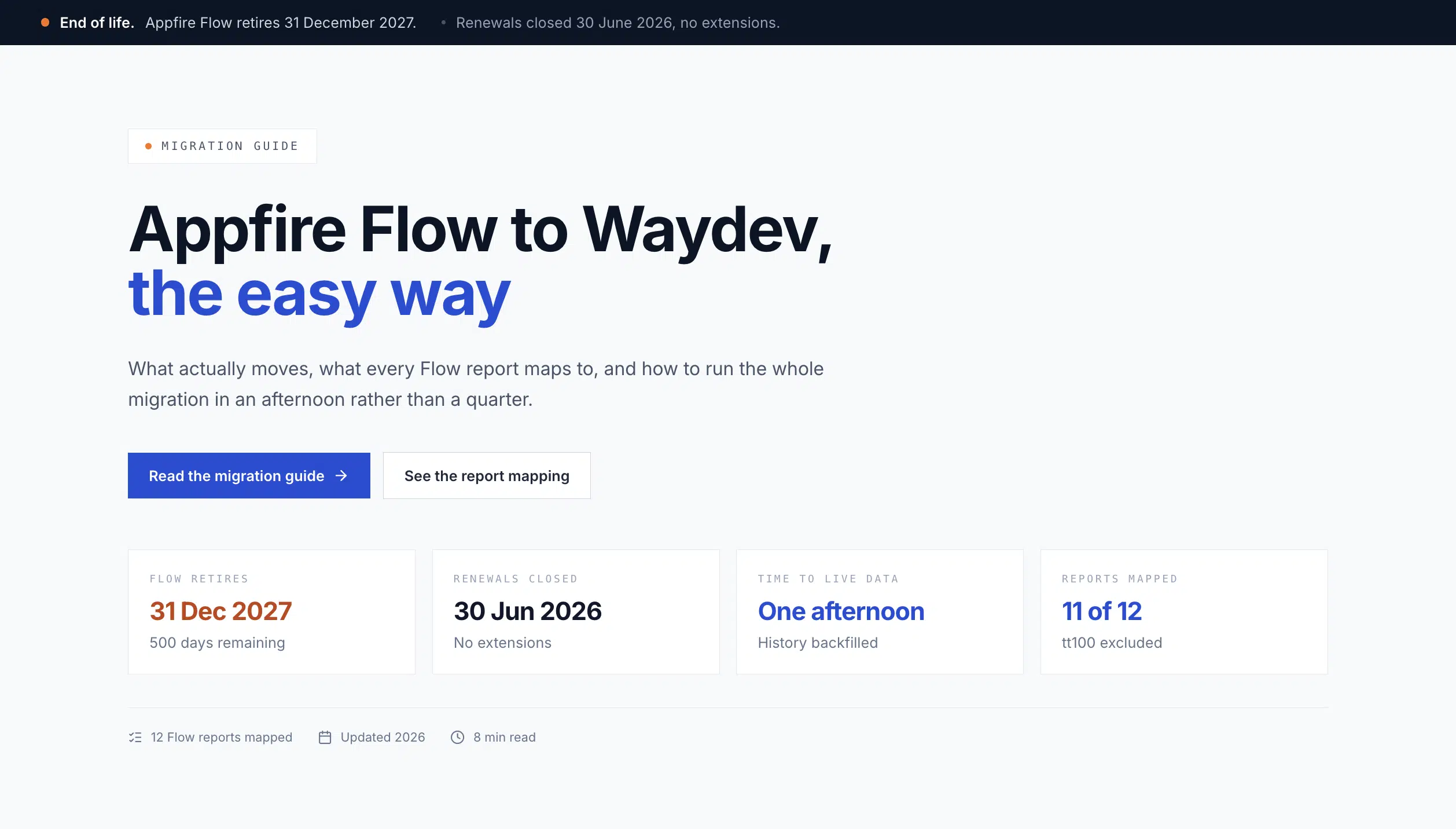
● Appfire Flow sunsets in 2027
Appfire Flow is shutting down, and every team that built dashboards, quarterly reviews, and reporting workflows on Flow, Pluralsight Flow, or GitPrime now has a real problem on a fixed deadline. This guide covers how to secure your historical data, evaluate Flow alternatives, and migrate to Waydev with your invoice matched and the migration done for you, free of charge.
Summary
The Flow sunset offer
Flow’s shutdown should not turn into a procurement project. For teams migrating from Appfire Flow, Waydev makes the commercial side disappear:
|
We match your Flow invoice Bring your current Flow invoice and Waydev matches it. Same line in the budget, already approved, no new spend to justify. You move to a maintained, AI-native platform at the price you were paying for a sunsetting one. |
Migration free of charge Our team handles the move end to end: integrations, team and repository mapping, report and dashboard recreation, and onboarding for your managers. Your full history rebuilds from your Git provider, so your baselines arrive with you. |
Claim the Flow sunset offer
Mention Flow on the call and bring your latest invoice.
Four decisions shape your evaluation more than any feature chart. Settle them before you take a single demo.
Flow holds years of your engineering history: cycle time trends, review patterns, commit-level baselines. Export everything before your account closes. Then ask every vendor one question: can you ingest this, or do we start from zero?
The tool is not the problem. The workflows are. Weekly team reviews. Executive dashboards for the CTO. Automated stakeholder reports. List them all. You are replacing processes, not a login.
Contract end is not your deadline. If leadership reviews engineering metrics monthly, your deadline is the next leadership meeting. If managers use the data weekly, it is sooner. Know what you are racing against.
Your VP of Engineering wants proof at scale. Your CISO wants security documentation. Your CFO wants budget continuity. Your managers want zero disruption. Talk to them before you pick a winner, not after.
Waydev and Flow (formerly GitPrime) grew up in the same category: Git-native engineering analytics. Most platforms in this space are ticket-first. Waydev, like Flow, is Git-first. Your team’s mental model transfers directly.
| Flow feature | Waydev equivalent | What you also get |
|---|---|---|
| Commit-level Git analytics | ✓ Git analytics | USPTO-patented. Work log, deep dive, repo-level views |
| Cycle time tracking | ✓ Cycle time | PR-level breakdown: coding, pickup, review, deploy |
| DORA metrics | ✓ DORA metrics | Benchmarks against industry baselines |
| PR review analytics | ✓ Review workflow | Review load, collaboration patterns, merge health |
| Team activity reports | ✓ Team dashboards | Configurable per team, role, or initiative |
| Executive reporting | ✓ Reports & Goals | Targets on any metric, tracked automatically |
| Historical trend data | ✓ History rebuild | History rebuilt directly from your Git provider |
Your most important historical data is not locked inside Flow. It lives in your repositories. When Waydev connects to GitHub, GitLab, Bitbucket, or Azure DevOps, it processes your full commit and PR history. Baselines, trends, and year-over-year comparisons rebuild from source. You do not start from zero. You start from day one of your Git history.
A forced migration is disruptive. It is also the moment to upgrade. Here is what Flow never gave you.
AI adoption / impact / ROI
Flow was built before AI-assisted development existed. It cannot tell you who is using Copilot, Cursor, or agentic tools, or what return the spend is generating. Waydev measures AI adoption, impact, and ROI across your org, tied to delivery outcomes, not seat counts.
Signals
Metrics that sit in a dashboard change nothing. Waydev Signals runs AI-evaluated checks on your engineering work and sends findings straight to the people who can act, via Slack. Risky PRs, stalled work, review bottlenecks. Before the retro, not after.
Goals & AutoGoals
Set measurable targets on any metric. Cycle time under three days. Review pickup under four hours. Waydev tracks progress automatically. AutoGoals suggests realistic targets from your own baselines, so you are not guessing.
Roles & Anonymization
Role-based access and anonymization controls give executives org-level visibility while protecting individual-level data. Works councils and legal teams have signed off on this model at enterprise scale, especially in Europe.
Vendor stability
Waydev is profitable and bootstrapped, with Fortune 500 customers including American Express, Dropbox, Caterpillar, and PwC. No pressure to pivot, get acquired, or sunset the product. After Flow, stability is a feature. Ask every vendor about theirs.
You do not have six months for an RFP. You do not need it. Four weeks gives you enough signal to decide with confidence.
WEEK 1
Pick two or three platforms based on your mapped processes and stakeholder concerns. Decline the rest.
WEEK 2
Ask each vendor to connect to a real repository and show your data in their platform. One ask, more signal than an hour of slides.
WEEK 3
Get specifics. Onboarding timeline. Historical data handling. Who owns the migration and what their SLA is.
WEEK 4
Choose. Use the memo template below to fast-track sign-off with your VP and finance stakeholders.
Internal memo template for sign-off
We are migrating from Appfire Flow following the product sunset. After evaluating the options, I recommend Waydev as our engineering intelligence platform.
Waydev covers everything Flow provided, including Git analytics, cycle time, DORA metrics, and executive reporting, and adds AI adoption, impact, and ROI measurement, automated Signals, and goal tracking. It rebuilds our historical baselines directly from Git, so we lose no trend data.
Waydev is used by Fortune 500 engineering organizations including American Express and PwC, holds a USPTO patent in Git analytics, and is recognized by Gartner in the Developer Productivity Insight Platforms category. The budget is already approved: it was paying for Flow.
Your inbox has been busy since the announcement. Everyone in this category knows Flow customers are shopping. Here is a candid brief, written in the same voice for every vendor, including Waydev at the end.
| Platform | Known for | Where it falls short | One question worth asking |
|---|---|---|---|
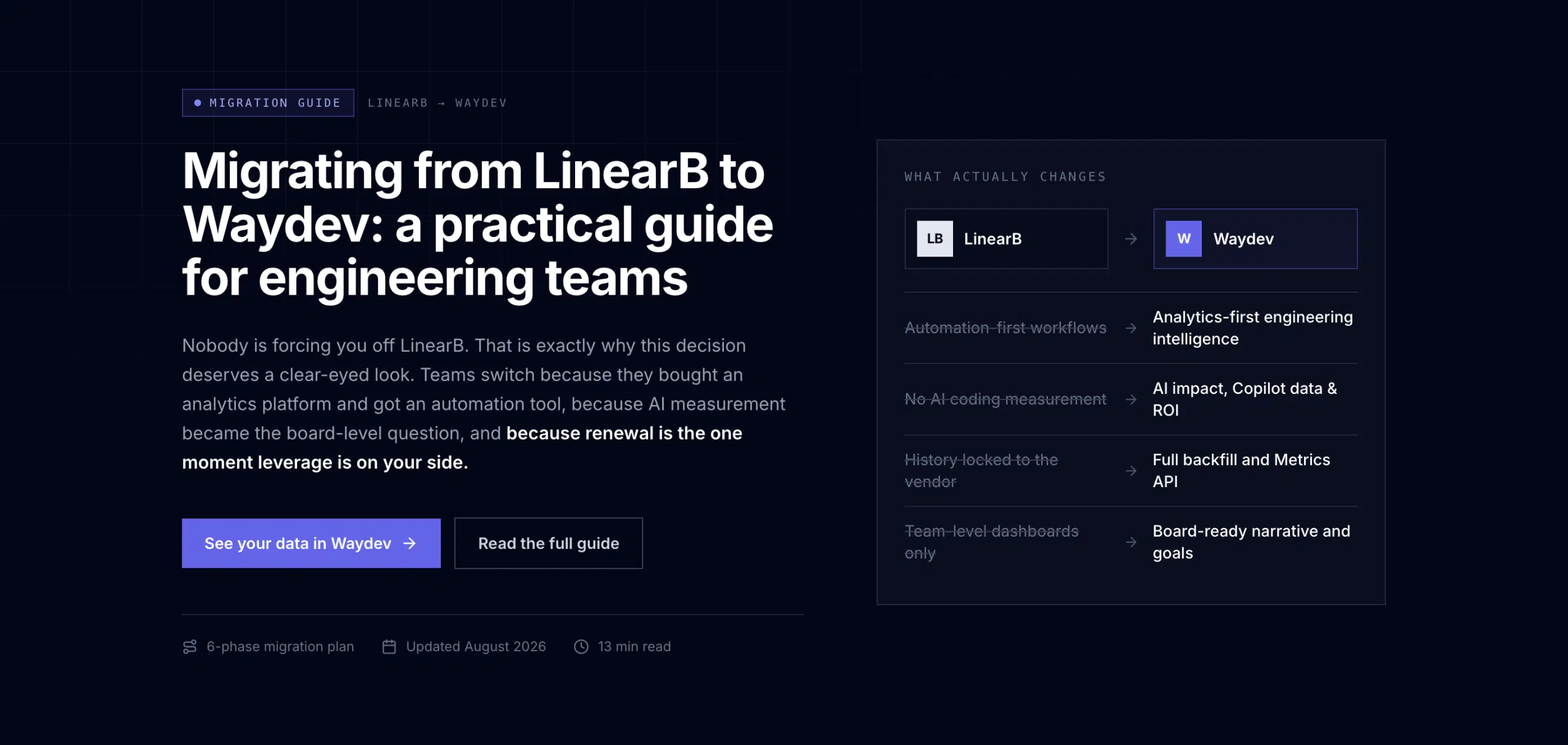
| LinearB | Workflow automation (gitStream), strong marketing motion | Automation-first, analytics second. Git-level depth is thinner than Flow’s. | Show me commit-level work patterns for one of my teams, the way Flow did. |
| DX | Developer experience surveys, academic framing | Survey-first. Sentiment tells you how people feel, not what is shipping. | If surveys flag a bottleneck, what delivery data proves it and tracks the fix? |
| Jellyfish | CFO-facing reporting, cost capitalization | Ticket-first model. Limited daily value for engineering managers. | What does an EM see each morning that helps them unblock the team today? |
| Swarmia | Clean setup, lower cost | Lighter at enterprise scale. Limited customization for large orgs. | Show me a deployment at 1,000+ engineers with role-based access controls. |
We are the closest architectural match to Flow because we are Git-first, and we go further on AI measurement, Signals, and Goals. What to pressure-test: ask us to connect your real repos on the first call. Ask about anonymization if you operate in Europe. Ask to talk to a customer at your scale.
Built for migrations, not fresh installs.
| Milestone | Timeline | What happens |
|---|---|---|
| Kickoff | Day 1 | Dedicated onboarding owner assigned, integration plan agreed |
| Technical setup | Days 1 to 14 | Git and PM tools connected, full history processed, teams mapped to your Flow structure |
| First value review | Day 30 | Baselines validated, first Goals and Signals live in Slack |
| Expanded rollout | Days 31 to 60 | Additional teams onboarded, executive reporting configured |
| Business review | Day 90 | Leadership review against your Flow-era baselines |
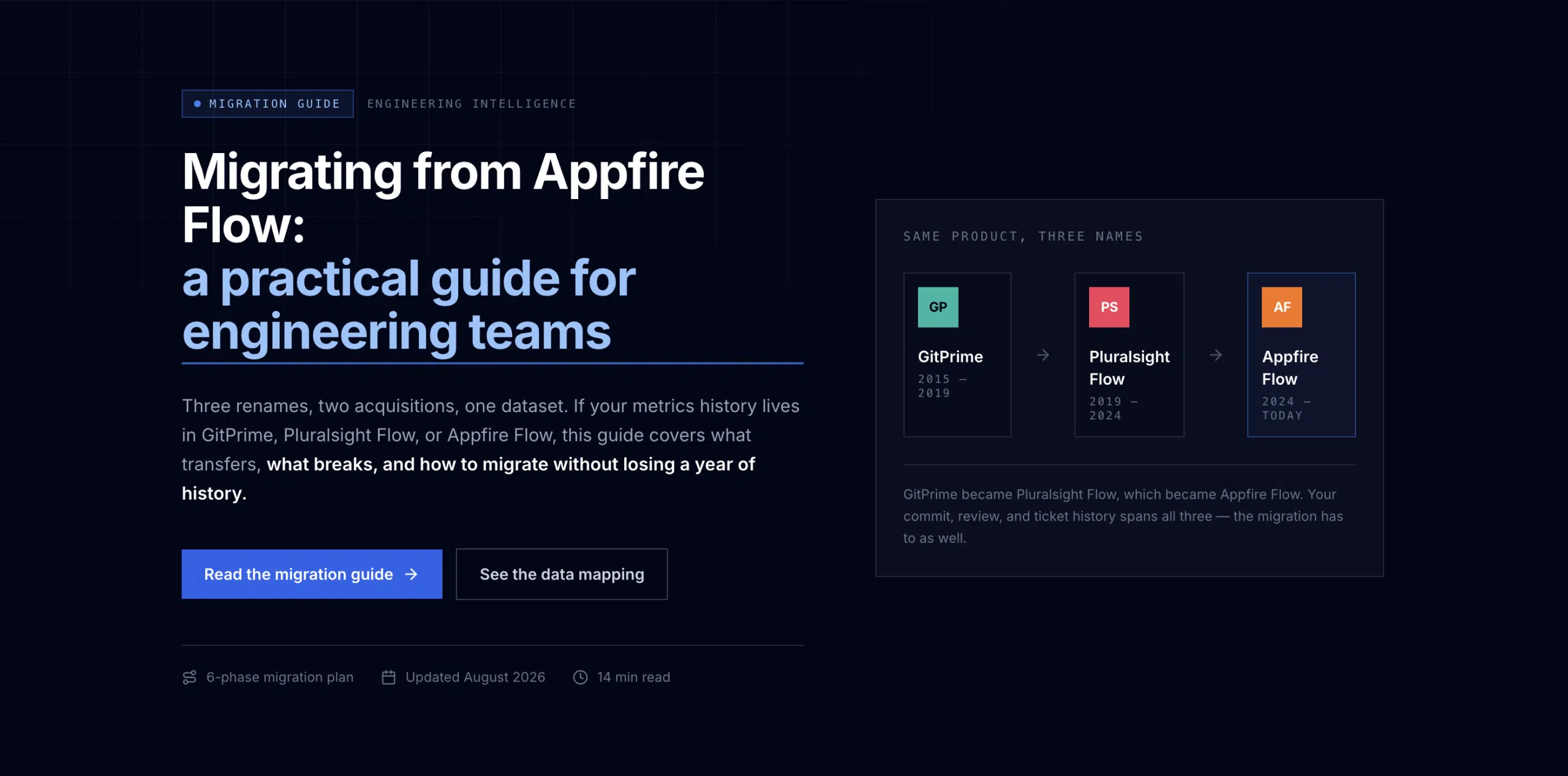
Appfire has announced that Flow (formerly Pluralsight Flow, originally GitPrime) will sunset in 2027. Your practical deadline is earlier: you need to be live on a Flow alternative before your final renewal, with time to export historical data and run both platforms in parallel. Confirm your exact end-of-support date with your Appfire account manager, then work backwards.
It depends on why you chose Flow. If you picked it because it was Git-first, the closest architectural match is Waydev: Git-native engineering analytics backed by a USPTO patent, the same commit-and-PR-level lineage as GitPrime, plus AI adoption, impact, and ROI measurement Flow never had. Ticket-first platforms like Jellyfish and survey-first platforms like DX measure differently and will change how your reports work. The comparison section above covers the honest trade-offs.
Technical setup takes one to two weeks. Full rollout is typically complete within 30 to 60 days depending on org size. For Flow customers, Waydev’s team handles the migration free of charge.
Yes, and better than an import. Waydev rebuilds your history directly from your Git provider, so your baselines come from source data rather than a Flow export. Flow exports can supplement where useful.
For Flow customers, Waydev matches your current Flow invoice, and migration services are free of charge: integrations, mapping, report recreation, and manager onboarding are handled by our team. In practice the budget conversation disappears, because the line item already exists and the price does not change.
In most cases, yes. It was paying for Flow. Procurement moves faster when the alternative is having no platform at all. The memo template above is designed for exactly that conversation.
Waydev is SOC 2 certified and never stores your source code. Full security documentation is available for CISO review on request.
Waydev tracks AI adoption, impact, and ROI across engineering, connecting AI tool usage to delivery outcomes at the PR level. You see who is adopting, whether output and quality are improving, and what the spend is returning.
Yes. Role-based access and anonymization controls are built in. Individual-level data can be restricted or anonymized while leadership keeps org-level visibility.
Related resources
GitPrime vs Waydev: a detailed comparison for teams still searching by Flow’s original name.
How Waydev works: from read-only connection to board-ready answers in days.
The WAY Framework: why Waydev is framework-agnostic, and what that protects you from.
DORA Metrics in Waydev: the delivery dashboard your Flow reports map onto.
We will not promise a perfect demo of your exact environment on day one. We will connect your real repositories on the first call and show you what your data looks like, including the history Flow was holding. The goal is a successful migration, not a great demo.
Ready to unlock your SDLC productivity?