Engineering Intelligence
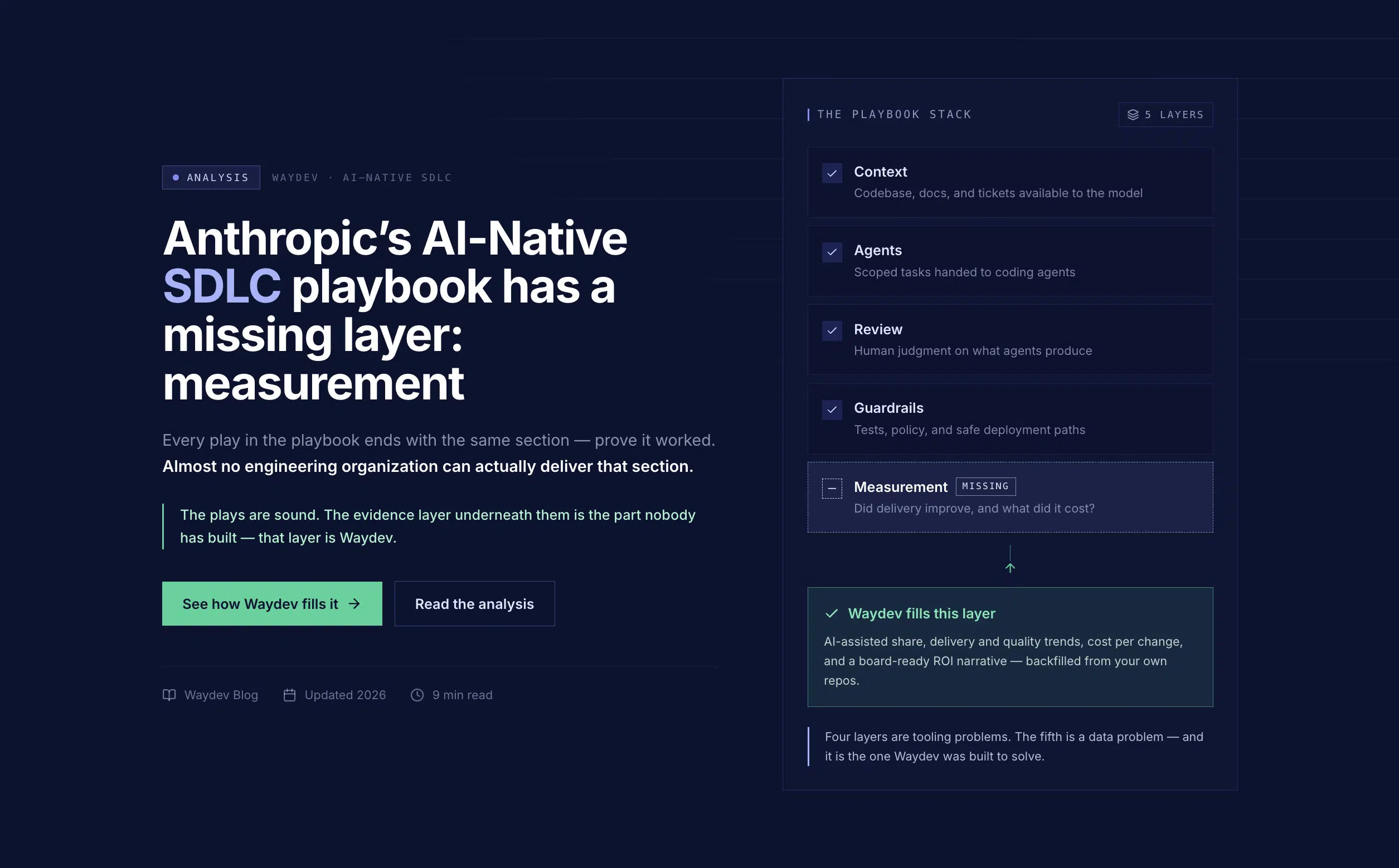
Every play in the playbook ends with the same section. Almost no engineering organization can actually deliver it.
Anthropic’s Applied AI team just published The AI-Native SDLC Playbook, and it’s the most concrete guide I’ve seen on restructuring the software development lifecycle around agentic AI. It opens with a line that belongs on the wall of every engineering leadership meeting: code is no longer the bottleneck. Your SDLC is.
We’ve watched this pattern play out across our customer base for over a year. Engineering teams adopt Claude Code or a similar agentic tool, the build phase collapses from weeks to hours, and then the work sits in the same review queues, approval gates, and change boards that were designed when writing code was the slow part. The productivity gain is real. It just gets absorbed by everything around the code.
The playbook’s answer is a six-stage loop, Plan through Maintain, where every stage commits an artifact to git: intent.md, spec.md, plan.md, the diff, the PR findings, the incident record. The chain of commits becomes the audit trail. Human attention moves up a level, from reading every line to judging intent and risk at the gates.
It’s a genuinely good framework. But there’s something buried in it that most readers will skim past, and it’s the part that decides whether any of it works.
Go through the playbook carefully and a pattern emerges. Every single play, without exception, closes with a measurement section. Leading indicator, lagging indicator, spelled out. Here is a sample of what it asks you to track:
Time from first conversation to a committed intent.md, and the share of intents accepted into design rather than closed.
source: git history, intent homeElapsed time between the intent.md commit and the spec.md commit for the same change. Requirements rework after build starts.
source: two git timestamps, per changeShare of changes that merge from the first implementation pass. Rework cycles per change. How often the merged diff still matches the committed plan.md.
source: PR metadata, diff comparisonFirst-pass CI success rate for agent-written changes. Review time per PR. Change failure rate.
source: CI system, incident trackerTime to first review. Defects and vulnerabilities caught before merge set against those escaping to production. Time spent waiting at each approval gate.
source: PR history, OpenTelemetry exportTime from control-band breach to an intent.md in the triage queue. Share of findings that become merged fixes. Repeat incidents of the same class.
source: detection logs, PR history, incident trackerThe playbook tells you where each signal lives. What it doesn’t tell you is how to pull those signals together, correlate them across stages, baseline them, and track them over time per team, per repo, and per initiative.
That isn’t a criticism. It isn’t Anthropic’s job to build your engineering intelligence layer. But it means the playbook carries an implicit prerequisite that almost nobody meets: the ability to measure the loop you are being asked to build.
The playbook describes a loop. A loop without instrumentation isn’t a loop. It’s an open pipe you are pouring agents into.
The playbook’s most ambitious idea sits in the final stage. A deterministic monitor watches production, a control band gets breached, Claude diagnoses the issue, and the finding re-enters the pipeline as a new intent.md. The loop feeds itself. People triage and approve rather than initiate.
Here is the problem with control bands: they require baselines.
When build stops being the constraint, the human-speed stages around it become the whole cycle time. Measuring only commits and deploys tells you nothing about the part that now dominates.
You cannot define what “breached” means for CI failure rate, PR cycle time, or change failure rate unless you know what normal looks like for your organization. And normal is different for a platform team than for a product team, different for a legacy monolith than for a greenfield service. A rolling 30-day baseline with Western Electric rules, which is exactly what the playbook recommends, is only as good as the historical data underneath it.
The same problem shows up at every gate. The playbook says human attention shifts to judging intent and risk. Fine. But how does a VP of Engineering know whether review quality is holding as agent output triples? How does a tech lead confirm the merged diff still matches the committed plan.md across forty repositories? These stop being questions you answer by glancing at a commit-count dashboard. They are correlation questions across the whole artifact chain.
The failure mode we see most: review time per PR drops, approval rates climb, and everyone calls it efficiency. Three months later the change failure rate catches up. Unmeasured autonomy at five times the output is not speed, it’s faster entropy.
Then there is the question the playbook doesn’t touch at all, the one every CFO and every board asks. Did any of this actually improve the business? AI adoption without impact measurement is just spend. When the build phase collapses from weeks to hours, someone has to prove that cycle time, rework, throughput, and change failure rate moved in the right direction, by how much, and where the remaining bottleneck now sits.
We built Waydev as an AI-native engineering intelligence platform. Waydev MCP is the piece that makes the AI-native SDLC measurable rather than aspirational.
The playbook’s central design decision works in your favor here: every stage commits an artifact to git. Waydev’s foundation is a USPTO-patented Git analytics engine, which means the artifact chain the playbook describes, intent to spec to plan to diff to PR findings to merge, is natively readable. It stops being a folder of markdown files and becomes a measurable pipeline with timestamps, authors, revisions, and outcomes at every stage.
Through MCP, that intelligence lives inside the loop rather than in a dashboard someone opens on Friday afternoon. The agent diagnosing a production anomaly can query the real baseline. The monitoring layer deciding whether a control band was breached pulls actual historical distributions instead of a guess someone hardcoded. The leadership report on whether the transformation is working writes itself from the same data the loop runs on.
Concretely, that covers the three measurement jobs the playbook creates:
Every leading and lagging indicator in the playbook maps to signals in git history, PR metadata, and CI events. Waydev collects, normalizes, and correlates them, so time from intent to spec and rework cycles per change become tracked metrics rather than a script someone wrote once and abandoned.
As agent output scales, Waydev shows whether review depth, review time, and defect escape rates are holding or quietly degrading. That is the difference between better-placed accountability and accountability theater.
AI adoption, AI-assisted output, cycle time, throughput, and quality, measured before and after, per team and per stage. This is how you answer the ROI question with data instead of anecdotes.
This is the WAY Framework in practice. Work-first, because we measure from the actual work artifacts in git rather than surveys or self-reporting. Agnostic, because the loop runs on Claude Code today and your measurement layer should never lock you to a single agent. Yours, because your baselines, your control bands, and your definition of healthy belong to your organization.
If you’re implementing the playbook, stand up the measurement layer before you scale the loop, not after. The sequence that works:
Baseline the SDLC you have today. You cannot demonstrate improvement without a before picture, and you cannot set control bands without historical distributions. This is the step teams skip, and the one they regret six months in when the board asks for the number.
Instrument the first stages you transform. For most teams that means Build and Deploy, where plan compliance, first-pass merge rate, and review time give you fast feedback on whether the new process is actually working or just feeling faster.
Wire the intelligence into the loop through MCP. Only then does the Maintain stage have real baselines to breach and real data to diagnose against. That is the point where the loop genuinely closes.
The organizations winning right now are not the ones with the most agents running. They are the ones who can prove what the agents changed.
The AI-native SDLC isn’t complete until the feedback loop is instrumented. If you’re hitting the measurement wall, that’s exactly what we do.
Book a demoSource: The AI-Native SDLC Playbook, Anthropic Applied AI team, August 2026. Waydev is an AI-native engineering intelligence platform measuring AI adoption, impact, and ROI across engineering organizations, trusted by Fortune 500 companies including American Express, Dropbox, Caterpillar, and PwC.
Ready to unlock your SDLC productivity?