If you are searching for a Codacy alternative, the first useful question is which job you are replacing. Codacy is a code quality and security platform: static analysis, security scanning, secrets detection, coverage and, since 2026, guardrails around AI-generated code. That is a different job from engineering intelligence, which is what Waydev does. This page covers the genuine alternatives to Codacy, what Codacy is now good at, and the cases where the tool you actually need is not a Codacy replacement at all.
Straight answer first: Waydev is not a drop-in replacement for Codacy, and we are not going to pretend otherwise. If you need static analysis on every pull request, look at the tools in the next section. If what you actually need is to know whether your delivery is improving and what your AI investment returned, keep reading past that. Plenty of teams run both.
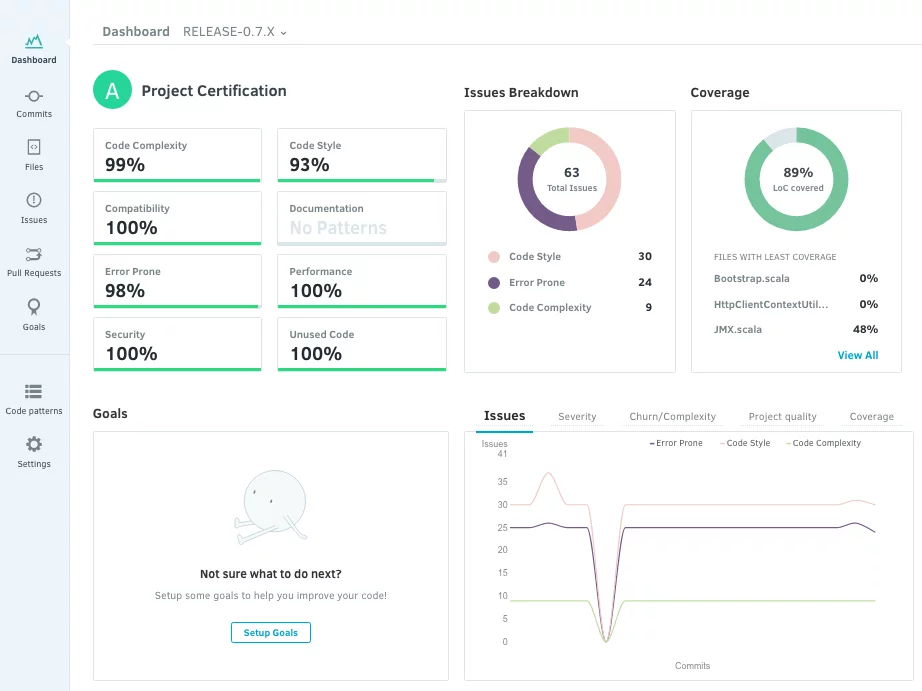
Codacy has moved a long way from the linting aggregator it started as. The current platform bundles automated quality analysis across dozens of languages, SAST, dependency and secrets scanning, coverage tracking and quality gates, connected to GitHub, GitLab or Bitbucket without CI pipeline changes.
Two 2026 additions are worth understanding even if you never buy the product. AI Guardrails is an IDE extension that scans code as an AI agent generates it, and can have the agent fix issues before a human ever sees the suggestion. It works in VS Code, IntelliJ, Cursor and Windsurf, and connects to Copilot, Claude and Gemini over MCP. AI Reviewer combines deterministic static analysis with LLM context on pull requests. Together they are a sensible answer to a real problem: AI writes more code than anyone can review carefully, so the check has to move earlier and become automatic.
That matters to us for a specific reason. Guardrails and AI Reviewer control the quality of AI-generated code as it enters your codebase. They do not tell you whether AI changed your delivery outcomes, what it cost, or whether the throughput gain survived contact with your change failure rate. Those are the questions engineering intelligence answers, and they arrive at the same leadership meeting.
| Tool | Best for | Trade-off |
|---|---|---|
| SonarQube and SonarCloud | The default enterprise choice. Deep language coverage, self-hosted option, mature quality gate model. | Heavier to operate, and pricing changes have pushed some teams to look elsewhere. |
| Semgrep | Security-led teams that want to write and enforce their own rules, with strong SAST. | More of a security tool than a general code quality dashboard. |
| DeepSource, Qodana | Modern alternatives with autofix; Qodana suits JetBrains-heavy shops. | Narrower ecosystems and smaller communities than Sonar. |
| GitHub Advanced Security | Teams entirely on GitHub who want scanning native to the platform. | Ties you further into one vendor, and does nothing for other providers. |
| AI PR reviewers | Context-aware review comments on pull requests, increasingly bundled with coding tools. | Non-deterministic. Useful alongside static analysis, not instead of it. |
Accurate as of September 2026 based on public information. Verify current capabilities and pricing with each vendor.
A good number of people who search for a Codacy alternative are not really shopping for static analysis. They bought Codacy hoping it would answer a management question, found that it answers an engineering question instead, and went looking again. If any of these is the question you are actually being asked, no code quality tool will get you there.
| The question | Code quality tool | Engineering intelligence |
|---|---|---|
| Is this pull request safe and maintainable? | Yes | No |
| Where is delivery slowing down, and at which stage? | No | Yes, via cycle time |
| What are our DORA metrics and are they trending the right way? | No | Yes, via DORA metrics |
| Did our AI coding investment actually pay back? | No | Yes, via AI ROI |
| How much engineering effort can we capitalize this quarter? | No | Yes, via cost capitalization |
| Is review load concentrated on too few people? | No | Yes, via merge quality |
Waydev reads your GitHub, GitLab, Bitbucket and Azure DevOps history, plus Jira and your CI systems, and turns it into delivery, quality and cost reporting without asking engineers for manual input. It is in production at Fortune 500 organizations including American Express, Dropbox and PwC.
AI measurement: adoption, impact and ROI across Copilot, Cursor, Claude Code and Codex, kept as three separate measurements so tool spend never gets reported as productivity.
Delivery: DORA, cycle time by stage, PR insights, velocity and sprint commitment.
Health and planning: Insights, benchmarking, Developer Experience surveys, resource planning, project costs.
Studio: custom dashboards, custom metrics, targets and a two-way API.
All of it sits under the WAY Framework: Work-first, Agnostic, Yours. It combines DORA, SPACE and Core 4 rather than replacing them with a proprietary index, so your measurement vocabulary stays yours if you ever leave us.
This is the common setup, and it is a good one. A code quality tool enforces the standard on the way in. Waydev tells you what that is doing to your delivery over time. Waydev also pulls Sonar code quality data in alongside your Git and ticketing signals, so quality trends sit next to cycle time and change failure rate rather than in a separate tab nobody opens.
The combination matters more in an agentic workflow. Guardrails-style tooling controls what AI-generated code looks like at the moment of writing. Engineering intelligence tells you whether all that generated code is actually reaching production faster and staying up once it does. We wrote about why those two must be measured separately in DORA metrics in the AI era and cost per accepted change.
Published on the pricing page, billed per active contributor rather than per seat, with unlimited users and unlimited teams on every plan. Pro starts at $348 per year per active contributor. Premium starts at $648 and includes the Planning, Automation, Studio and AI modules plus SSO and API access. Enterprise adds on-premise Git and ticketing integrations, self-hosted deployment and dedicated support.
To be direct about the comparison: Waydev is not the cheaper purchase next to a per-seat code quality tool, and it is not trying to be. It is a different budget line answering a different question, usually asked by a different person. Teams under roughly fifty engineers generally get more value from tightening code quality first.
Can Waydev replace Codacy?
No. We do not run static analysis, SAST or secrets scanning, and we will not pretend to. If you drop Codacy, replace it with a code quality tool from the table above.
Does Waydev have a free plan?
No. Plans start at $348 per year per active contributor, and we run proof of concept engagements on your own repositories so you can see real numbers before committing.
Does Waydev read code quality data?
Yes. We pull Sonar code quality metrics in alongside Git and ticketing data so quality sits in the same view as delivery. See all integrations.
Still deciding between engineering intelligence platforms? Compare us with Jellyfish, LinearB, DX, Swarmia and Allstacks, or start at the comparison hub.
The short version
Codacy answers whether the code is good. Waydev answers whether the engineering is working and what the AI spend returned. If you came here for the first question, take one of the alternatives above. If you came for the second, you were looking for a different category all along.
See your own delivery data
Connect your repositories and we will backfill your history so you are looking at your own delivery and AI numbers, not a demo tenant. You keep the analysis either way.
Further reading: The WAY Framework · DORA metrics · Measuring AI ROI in engineering · DORA Metrics Playbook · AI ROI calculator · Pricing
Comparison accurate as of September 2026, based on publicly available information about Codacy and the other tools named. If anything here is out of date, tell us and we will correct it.
Ready to unlock your SDLC productivity?