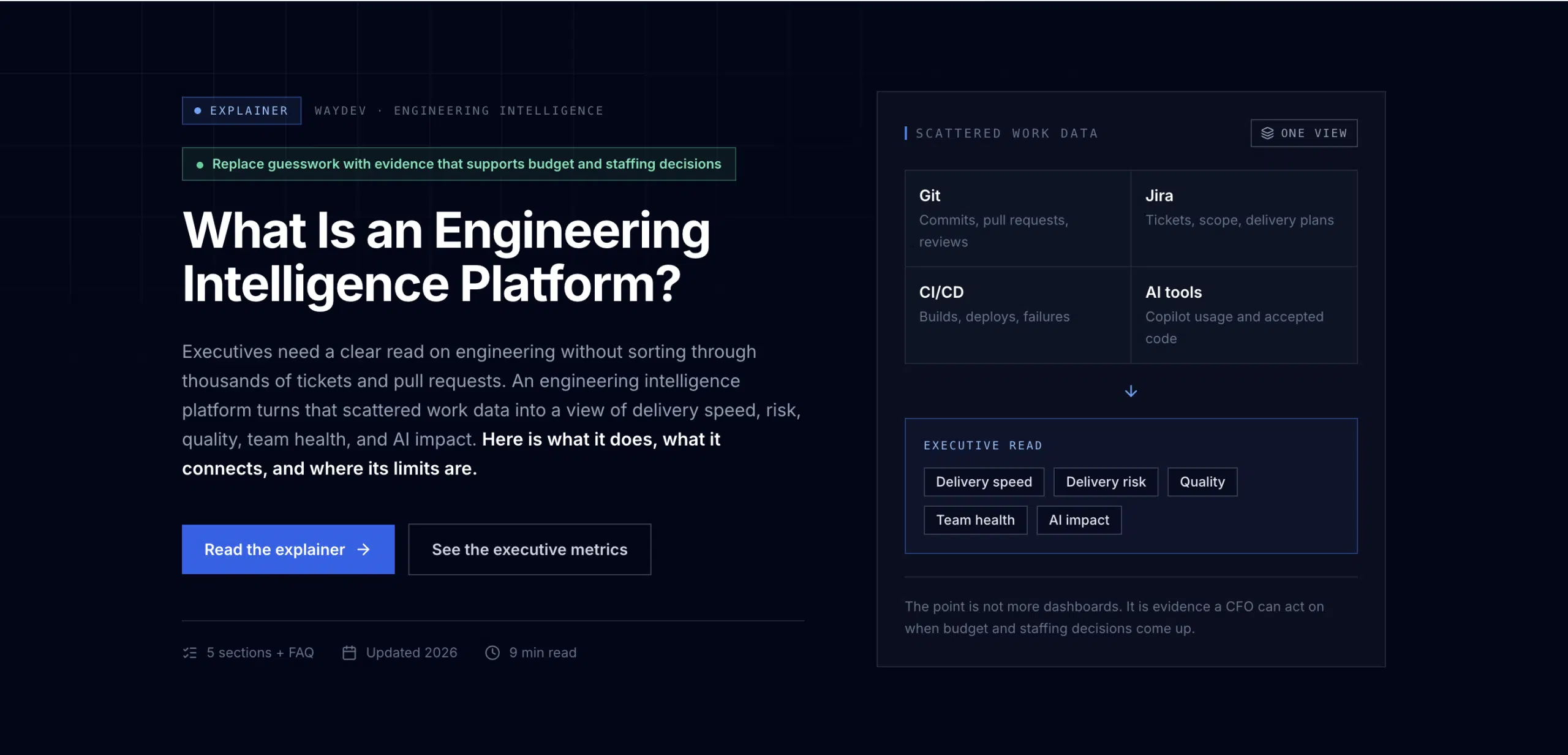
Executives need a clear read on engineering without sorting through thousands of tickets and pull requests. An engineering intelligence platform turns that scattered work data into a view of delivery speed, risk, quality, team health, and AI impact. For large engineering organizations, the goal is simple: replace guesswork with evidence that supports budget and staffing decisions.
An engineering intelligence platform for executives connects software delivery data to business decisions. It shows where work slows down, which investments improve output, and where risk may affect customers or revenue.
That distinction matters. GitHub, Jira, and CI/CD systems record activity. They don’t explain the meaning behind it. A leadership team may see more pull requests but still lack an answer to a harder question: did delivery improve, or did rework increase?
Good platforms combine several views of the engineering system. Delivery metrics show how work moves. Quality metrics show what happens after release. Developer experience, or DX, shows the friction that makes work harder. AI adoption data shows if coding tools change outcomes rather than just usage.
Waydev brings these views together through metric categories that include productivity, delivery, code quality, DORA, SPACE, and developer experience. That breadth gives a CTO more context than a single velocity chart. We can also frame the data around AI adoption, impact, and return on investment at the team and organization level.
A review of three platforms found a useful gap in the market. Only one explicitly described a unified manager dashboard. That means many products promise executive visibility while still making leaders assemble the picture themselves. Metric breadth can help, but the executive view must remain easy to read.
 Key Takeaway: Executive value comes from connecting engineering signals to decisions about budget, capacity, risk, and customer commitments.
These platforms gather data across the software development life cycle, or SDLC. That can include Git activity, Jira issues, pull requests, code review, build runs, deployments, incidents, and quality checks.
The platform then maps records from different systems into a common model. A Jira ticket can connect to its branch, pull request, build, release, and incident. Leaders can see the full path instead of a set of isolated events.
That connection also helps explain scope creep. Suppose a project has many open issues but few completed releases. A combined view can show whether the cause is review delay, failed builds, unclear priorities, or work that keeps changing after development starts.
Integration design matters at enterprise scale. Collaboration-focused connections may bring in tools such as Slack and Notion alongside GitHub and Jira. Cloud and business intelligence connections may focus on AWS, Azure, Google Cloud, Tableau, or another business intelligence platform. The right mix depends on where your source data lives and how your CFO or board reviews performance.
Waydev is designed to work with the systems engineering teams already use. That reduces the need for a new work log. The platform reads existing delivery signals and turns them into dashboards, reports, and decision support.
Data quality still sets the ceiling. If teams use different issue types, skip status updates, or split work across disconnected projects, the platform needs rules for normalization. A clean integration plan should define ownership for those rules before executives rely on the output.
Executives don’t need every metric. They need a small set that answers a business question. An engineering intelligence platform should connect flow, quality, risk, capacity, and experience.
| Executive question | Useful signal | Decision it can support |
|---|---|---|
| Can we ship on time? | Lead time, cycle time, throughput | Adjust scope or capacity |
| Is delivery becoming safer? | Change failure rate, recovery time, defect trends | Fund quality work or release controls |
| Where is work stuck? | Review wait, aging work, blocked items | Remove a handoff or fix a team dependency |
| Is AI spend paying off? | AI adoption linked to flow, quality, and rework | Expand, change, or stop an AI investment |
| Can teams sustain the pace? | SPACE and developer experience signals | Improve tools, staffing, or team conditions |
DORA provides four well-known delivery measures: deployment frequency, lead time for changes, change failure rate, and time to restore service. These measures describe software delivery performance rather than individual effort.
That last point is important. Metrics should help leaders improve a system. They should not rank individual engineers. A high pull request count may reflect small tasks, while a low count may reflect deep work or incident response.
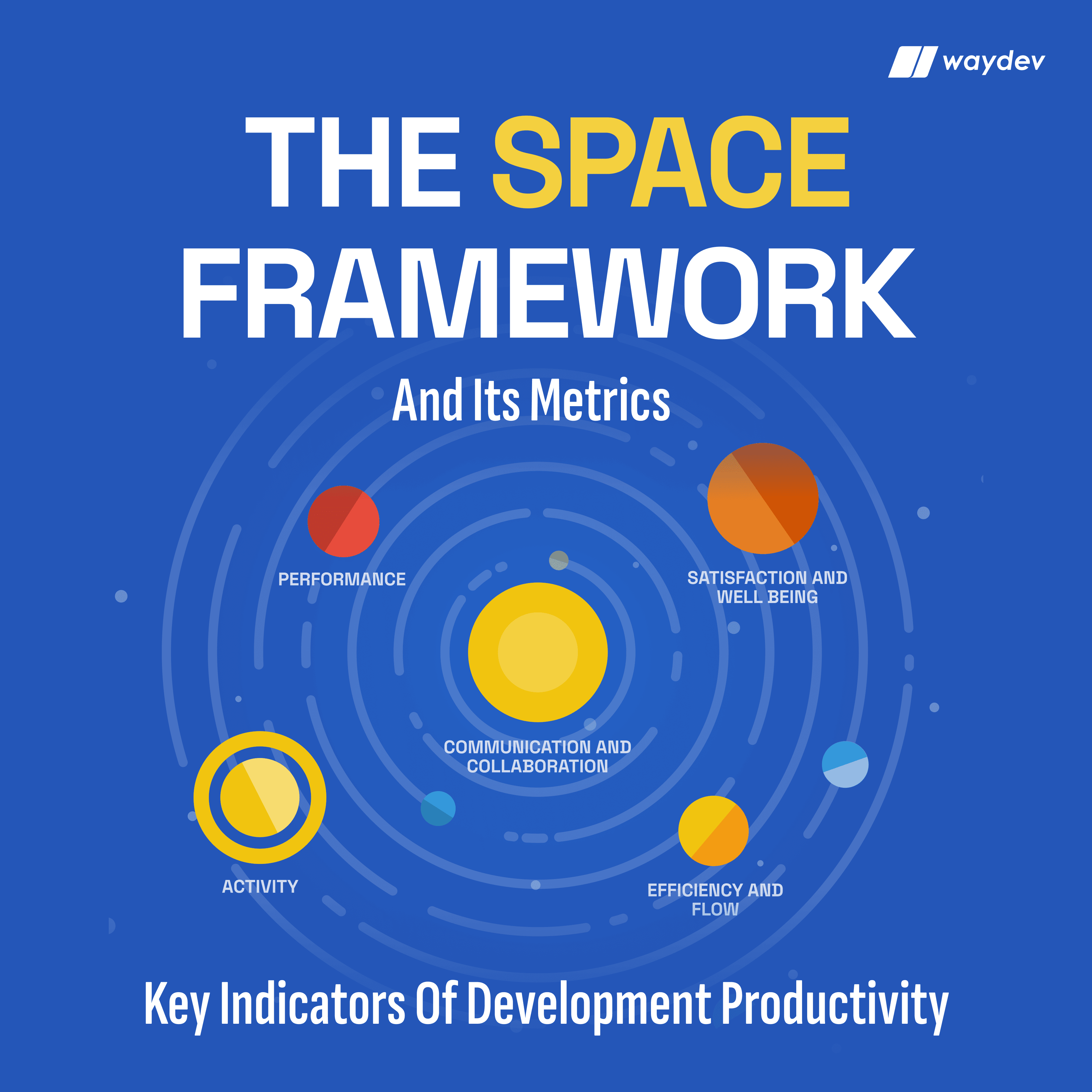
Waydev uses DORA alongside SPACE and developer experience signals. DORA shows delivery outcomes. SPACE adds signals about satisfaction, performance, activity, communication, and efficiency. Developer experience signals help explain the friction behind the numbers, such as slow builds or poor review flow.
AI ROI needs the same discipline. Adoption alone is weak evidence. A board-ready view should connect tool use with cycle time, rework, quality, and capacity. Our guide to measuring AI coding ROI takes that outcome-based view.
AI adds value when it explains a signal and suggests a next move. It should not merely place a chatbot beside an old dashboard.
A useful AI layer can summarize a filtered set of work. For example, a CTO might ask which customer projects carry the highest delivery risk this quarter. The system can inspect priority, age, cycle time, dependencies, and quality signals, then return a short answer tied to the underlying records.
Interactive analysis is the next step. Instead of waiting for a monthly report, an executive can ask:
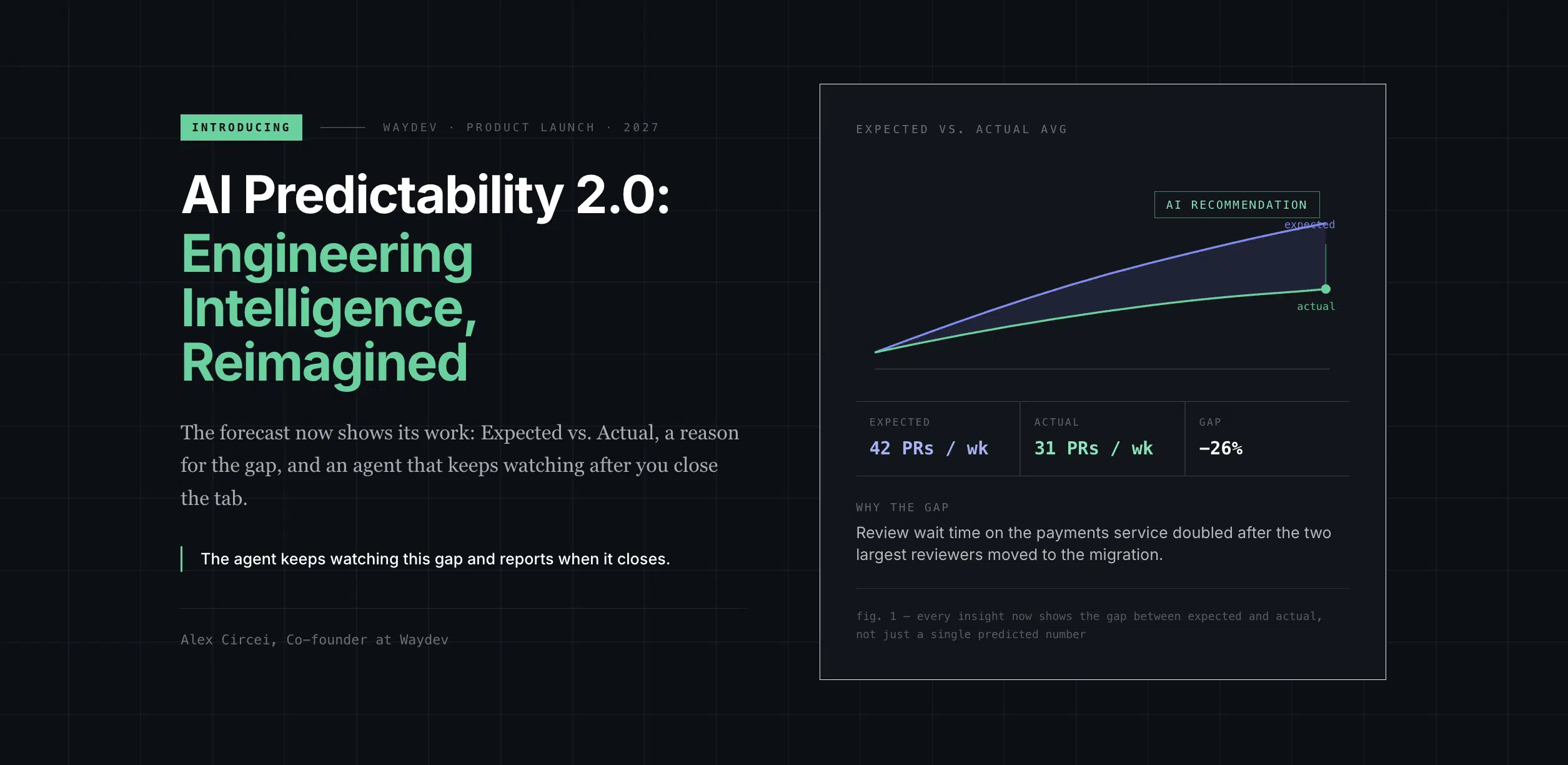
Waydev supports this model through Ask Waydev, AI Checkpoints, Signals, Predict & Improve, and MCP integration. Ask Waydev gives leaders a natural language path into engineering data. AI Checkpoints can help mark adoption milestones. Signals surface changes that deserve attention, while Predict & Improve connects past patterns to possible next actions.
Our AI-native engineering intelligence platform is built around questions such as how AI affects delivery speed and quality. That makes the conversation more useful than a report that only shows tool adoption.
Still, AI recommendations need guardrails. The system should show the records behind a claim, state when data is missing, and let a leader inspect the filter used. A confident answer with weak evidence can send a budget review in the wrong direction.
Pro Tip: Ask AI to compare outcomes before and after adoption, then inspect quality and rework before claiming productivity gains.
Adopting an engineering intelligence platform is a data and change project. The technology may connect quickly, but trust takes longer.
Start with a narrow executive question. It could be delivery risk for strategic accounts or the return from AI coding tools. Define the decisions that question should support. Then map the systems that contain the needed evidence.
Governance should cover several areas:
AI risk management is an ongoing process. That principle fits engineering intelligence well. Leaders should review how the system uses data, how it produces recommendations, and how people respond to those recommendations.
Security also matters because engineering data can reveal customer names, product plans, code activity, and delivery weaknesses. A platform review should ask where data is stored, how access is logged, whether exports are controlled, and how third-party model calls are handled.
There are limits. A platform can’t fix poor planning by itself. It can’t infer every customer outcome from a ticket. It also can’t turn a disputed metric definition into an objective fact.
Research reviewed for this topic found no free tier or trial across the three platforms examined. Pricing and product limits were also unclear in the available data. For a company with 500 or more engineers, request a working session that uses your own toolchain and a real executive question.
Waydev is a fit when you want broad engineering measurement with a strong focus on AI adoption and ROI. We recommend starting with one scorecard, one owner, and one quarterly decision. Expand only after leaders and engineering teams trust the view.
An engineering intelligence platform for executives combines data from development tools and turns it into business-level insight. It can show delivery speed, quality risk, team health, customer exposure, and AI impact. The best systems explain what changed and why, rather than forcing leaders to read raw tickets or isolated dashboard widgets.
It measures engineering performance through team and organization signals such as cycle time, deployment frequency, change failure rate, recovery time, work aging, quality, and developer experience. It should avoid individual rankings. The purpose is to find system friction and guide decisions about staffing, process, tooling, and investment.
Yes, an engineering intelligence platform can measure AI coding ROI when it connects adoption data with delivery and quality outcomes. Usage alone doesn’t prove value. Leaders should compare AI adoption with cycle time, rework, defects, release flow, and capacity, then include enablement and license costs in the business case.
Executives should expect connections to Git providers, Jira or another issue tracker, CI/CD systems, and quality or incident tools. The exact set depends on the company stack. More integrations aren’t always better. The key is linking one item of work to its code change, review, build, release, and customer or service impact.
No, engineering intelligence usually sits above Jira, GitHub, and related systems. Those tools remain the systems where teams plan and deliver work. The intelligence layer adds context by joining records across systems. It helps leaders understand flow and risk without asking engineers to maintain another work log.
A CTO should begin with one business decision and a small set of trusted metrics. Define the data sources, agree on metric meanings, and review the first results with engineering teams. Keep the first rollout focused on team and organization improvement. Add AI recommendations only after leaders can trace insights back to source data.
Choose an engineering intelligence platform that connects delivery data to financial and customer decisions, not one that simply adds more charts. For large organizations focused on AI spend, Waydev is worth evaluating because it combines DORA, SPACE, DX, delivery, quality, and AI ROI signals. Start with one executive question and test the answer against your own data.
Ready to unlock your SDLC productivity?