Will Larson published a piece recently arguing that good engineering management is not a fixed standard, it is a fad that gets rewritten every few years to match whatever the business needs at the time. It is one of the more useful things written about engineering leadership this year, and it changed how we think about what our own platform should and should not try to measure. This is our response to it, and an attempt to separate the skills that survive every cycle from the ones that only look good in the cycle that rewards them.
This piece is a response to Will Larson’s “Good engineering management” is a fad, on his blog Irrational Exuberance. Larson is the author of An Elegant Puzzle, Staff Engineer, The Engineering Executive’s Primer and Crafting Engineering Strategy. The era framework and the eight-skill model below are his; we are agreeing with the argument and adding what we think it means for measurement.
Key takeaways
What counts as good engineering leadership changes every decade, not because morality changes but because business conditions do.
Four core skills survive every era: execution, team building, ownership and alignment.
Four growth skills separate good leaders from future-proof ones: taste, clarity, navigating ambiguity, and working across timescales.
System data can make execution and alignment measurable. It cannot give you taste, clarity, or the energy to keep evolving for forty years.
The 2027 planning cycle is rewarding leaders who can prove execution rather than describe it, especially on AI.
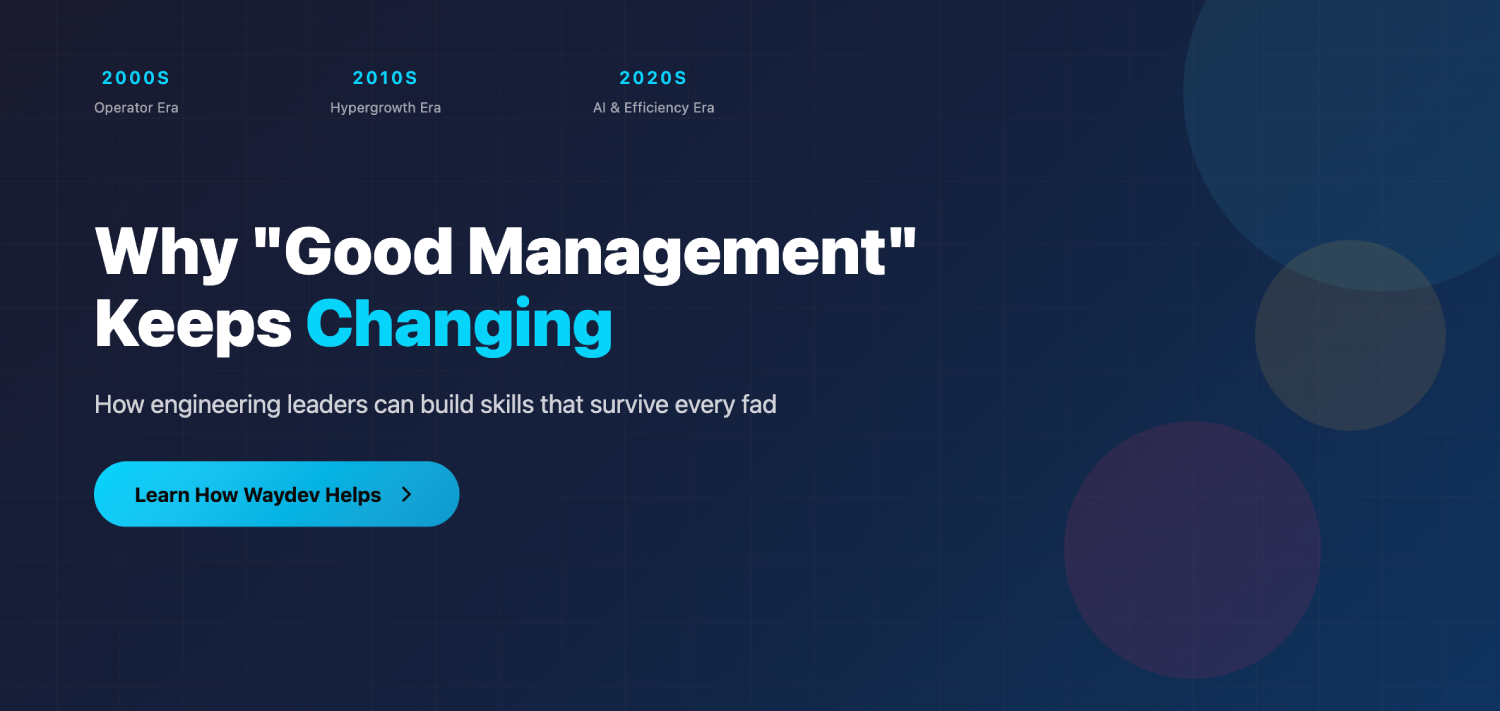
Larson’s central point is that the industry keeps dressing up an economic shift as a moral discovery. Each time expectations of managers change, someone frames it as evidence that the old way was wrong all along, when really the business just needs something different now. A manager who was celebrated for one set of behaviours can find themselves labelled ineffective a few years later, having changed nothing except the calendar.
Three eras make the pattern visible.
2000s
The operator
Managers wrote code, handled escalations, and navigated internal politics to ship. Leadership meant clearing the blocker in front of you.
2010s
The hypergrowth coach
Hiring became the constraint, so managers were told to step back from code, build teams fast, and optimise for retention and culture. The moral gloss on this era was that good managers empower people.
2020s
Efficiency and AI
Capital got expensive and AI tooling arrived at the same time, and managers who thrived on coaching and process in the last era can look like unnecessary overhead in this one. The moral gloss this time is that good managers eliminate inefficiency.
Both narratives contain something true. Neither is the whole story. As Larson puts it, the industry tells you each shift is a moral discovery, but it is “pretty much always about business realities changing.”
If the fashionable skill set keeps changing, the useful question is what to build instead of chasing it. Larson’s framework splits eight durable skills into two tiers: the core skills every manager needs regardless of era, and the growth skills that separate a good manager from one who keeps getting more senior.
Figure 1
Eight skills, two tiers
Execution. Leading teams that deliver, consistently, through on-call, incidents, sprints and complex projects. Nothing else on this list matters if this one is missing.
Team building. Hiring, developing and retaining strong engineers, while holding the line between what the team needs and what the business expects.
Ownership. Taking responsibility for outcomes when reality is messy, and finding a path forward rather than a reason it is someone else’s problem.
Alignment. Keeping a shared understanding across your team, stakeholders, leadership and customers. Misalignment slows delivery more reliably than any technical problem does.
Taste. Recognising what good actually looks like in a technical design, a product decision, or an outcome, when there is no rubric to check it against.
Clarity. Explaining a decision, a priority or a tradeoff so plainly that it removes confusion rather than adding a layer of it.
Navigating ambiguity. Turning an unstructured mess into a structured plan. Senior leaders get handed the messiest problems precisely because they can be trusted to do this.
Working across timescales. Protecting a long-term strategy while still shipping this quarter’s commitments, without letting either one quietly eat the other.
We build an engineering intelligence platform, so it would be convenient to claim it makes all eight skills measurable. It does not, and pretending otherwise would be exactly the kind of moral gloss Larson’s post is warning against. Here is where it actually helps, and where it plainly cannot.
| Skill | Can data help? | How |
|---|---|---|
| Execution | Yes, directly | Cycle time by stage, DORA metrics, and where bottlenecks actually form. |
| Alignment | Partly | A shared, trusted view of delivery, AI usage and risk that everyone in the room is looking at, via Insights and custom dashboards. |
| Working across timescales | Partly | Long-term trend beside short-term delivery, so a quarter’s decision does not silently undercut the strategy. See benchmark and resource planning. |
| Team building | Indirectly at best | Developer Experience surveys surface friction. Hiring judgment is not something a dashboard supplies. |
| Ownership | No | This is character under pressure. No metric substitutes for it. |
| Taste, clarity, navigating ambiguity | No | Judgment, developed through experience and mentorship. Not something a platform can hand you. |
That gap is not a shortcoming to apologise for. Six of these eight skills are, correctly, things a tool cannot give you. What data can do is stop your gut feeling on the other two from being your only evidence, which matters more than it used to, because 2027 planning is rewarding leaders who can prove execution rather than describe it.
The efficiency and AI era Larson describes is the one where execution stopped being assumed and started being audited. Boards want to know what AI tooling actually returned, not whether teams feel more productive. That is an execution and alignment question at heart, and it needs the same separation we argue for everywhere else on this site: adoption, impact and ROI as three distinct answers rather than one reassuring number.
The leaders who look strong in this era are not necessarily better managers than the ones who thrived in the coaching era. They are the ones whose core skills happen to be legible to what the business is asking right now, which is exactly Larson’s point restated. Building all four core skills, rather than over-indexing on whichever one the current era applauds, is what keeps you standing when the era ends.
Larson’s post ends on something no dashboard touches, and it is worth repeating rather than smoothing over. A career spent chasing the mathematically optimal allocation of your time will burn you out before it makes you senior. The better goal is a sustainable mix: some work that energises you specifically, not only the work that is currently efficient, with deliberate tradeoffs across pace, learning, prestige and pay.
Design the career for forty years, not for the next performance cycle. Nothing about that is measurable, and it is arguably the skill that determines whether you get the chance to use the other eight for long enough to matter.
The short version
The industry will keep rewriting what it wants from you every few years and will keep calling each rewrite a moral discovery. Build execution, team building, ownership and alignment as non-negotiables, develop taste, clarity, judgment under ambiguity and a sense of timescale as what makes you senior, and measure the two of those eight that data can actually see. The rest is judgment, and no platform, ours included, replaces it.
Make execution and alignment measurable
Connect your repositories and we will backfill your history, so your team has a shared, trusted view of delivery and AI impact, not a gut feeling everyone reads differently.
Source: Will Larson, “Good engineering management” is a fad, on Irrational Exuberance.
For engineering leaders: Engineering Managers · Becoming a great engineering manager · Engineering manager responsibilities · Engineering Leaders Handbook
Related: The WAY Framework · Developer Experience · Measuring AI ROI · DORA metrics
Ready to unlock your SDLC productivity?