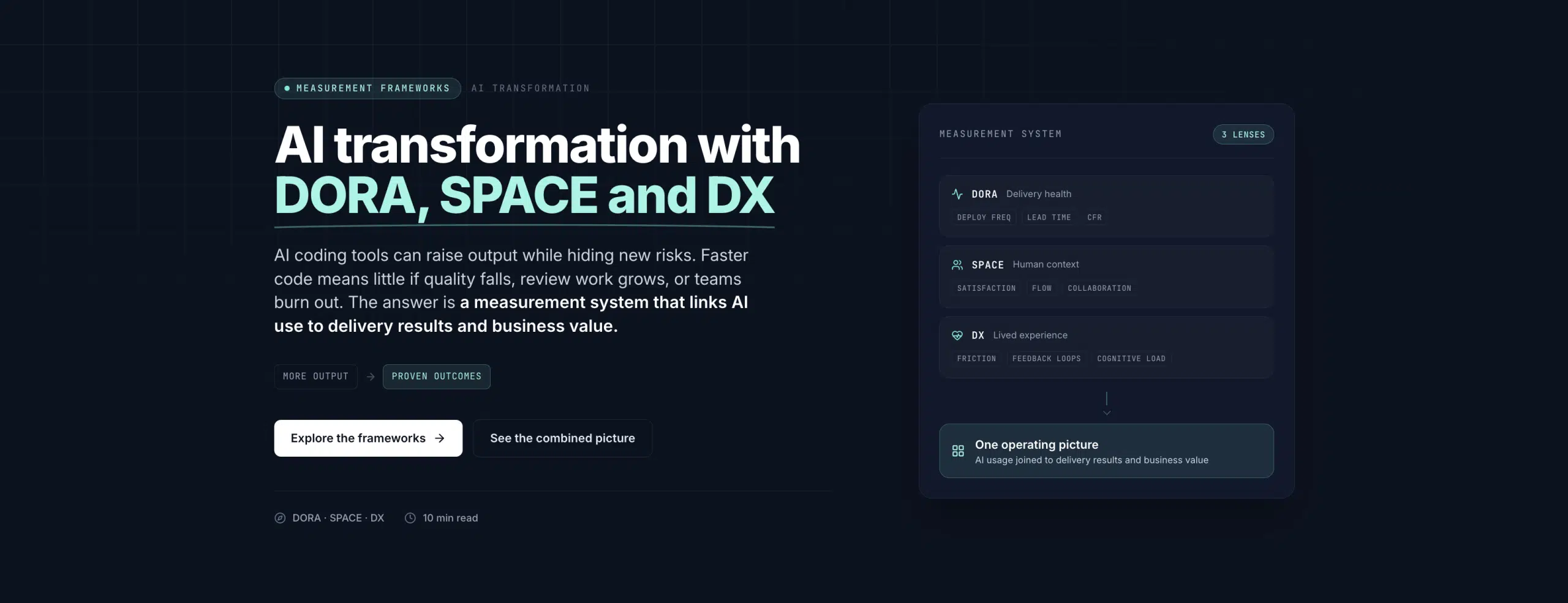
AI coding tools can raise output while hiding new risks. Faster code means little if quality falls, review work grows, or teams burn out. The answer is a measurement system that links AI use to delivery results and business value. DORA shows delivery health. SPACE adds human context. DX frameworks connect both to the way engineers experience work. Waydev brings these views into one operating picture.
AI transformation measurement must prove that new tools improve business outcomes, not just activity. For a VP of Engineering, that means showing the CFO where AI spend changes delivery speed, quality, risk, or capacity.
Start with a simple chain:
Many teams stop at the first point. They count seats, prompts, or AI-assisted pull requests. Those figures show use. They don’t show value.
Imagine that an engineering group doubles its use of an AI assistant. At the same time, lead time grows because reviewers face larger pull requests. Change failure rate also rises. An adoption dashboard may call this progress. A board-level view should call it a warning.
That is why measurement needs several layers. DORA measures delivery outcomes. SPACE helps explain the conditions behind those outcomes. DX adds a focused view of the tools, systems, and workflows that shape daily engineering work.
| Question | Useful framework | Executive decision it supports |
|---|---|---|
| Are changes reaching production faster? | DORA | Invest in delivery flow or remove a bottleneck |
| Is the team able to sustain the pace? | SPACE | Fix friction, overload, or weak collaboration |
| Which work conditions slow engineers down? | DX | Prioritize platform and workflow improvements |
| Is AI use linked to better outcomes? | Combined view | Expand, change, or stop an AI investment |
The measurement model also needs a fair unit of analysis. Use teams, services, products, or value streams. Don’t rank individuals by commit count or AI usage. Individual counts invite bad behavior and say little about customer value.
A sound baseline should cover a period before a major AI rollout. Then compare later periods with care. Keep the product area, release type, and team shape in view. A team shipping a high-risk migration can’t be judged against a team making small feature changes.
Waydev helps engineering leaders bring delivery data into a shared view. Its engineering intelligence approach covers adoption signals alongside DORA, SPACE, and DX measures. Leaders can then discuss AI spend with objective data instead of a collection of vendor claims.

The goal is a decision loop. First, measure a baseline. Then, introduce a controlled change. Once enough data has gathered, compare outcomes and decide what happens next. That discipline keeps AI transformation tied to the operating plan.
DORA helps answer the first executive question: does AI improve the software delivery system? Its core measures focus on how often teams deploy, how long changes take, and how safely teams recover when something fails.
The common DORA measures are:
These measures provide a way to assess software delivery performance. A related resource is available. The value comes from reading them together. A rise in deployment frequency means little if change failure rate rises at the same time.
AI can affect each measure in a different way. Code assistants may reduce the time needed to draft a change. That can lower lead time when reviews and tests keep pace. But higher code volume can also increase review load, which slows the path to production.
Use DORA to test a clear claim. For example: “AI-assisted work will help this service ship small changes more often without raising failure rates.” Define the service, the time window, and the success condition before the rollout.
Small changes matter here. If AI produces larger pull requests, split size should become part of the review. If the team ships more often but incidents take longer to resolve, inspect the incident workflow. The metric points to a system question. It doesn’t identify blame.
Executives should also avoid comparing unlike teams. A platform team with frequent infrastructure releases has a different delivery pattern from a payments team with strict controls. Use internal baselines first. External benchmarks can add context later, but they shouldn’t replace local knowledge.
Waydev can place DORA data beside AI adoption signals. That lets leaders ask whether teams using an assistant see a change in delivery outcomes. It also helps separate correlation from a useful operating hypothesis. AI use may rise during a major release, for example, while delivery slows because the release itself is complex.
A DORA dashboard becomes more useful when it shows trend, scope, and cause. Trend shows movement over time. Scope shows which services or teams changed. Cause requires another layer, such as review wait time, work type, incident load, or developer feedback.
For a board discussion, keep the message plain. “AI reduced lead time” is incomplete. Say which value stream changed, by how much relative to its baseline, and whether quality stayed within its guardrails.
SPACE adds the human and team conditions that DORA cannot show on its own. In AI transformation work, that context matters because a short lead time may hide review fatigue, poor trust, or constant interruption.
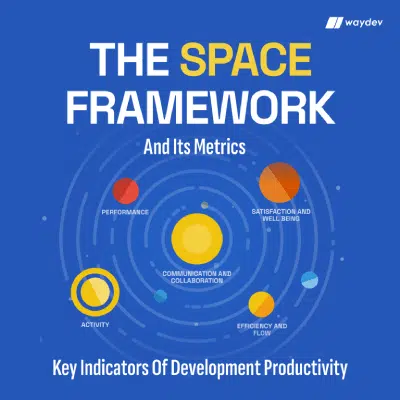
SPACE covers five dimensions:
The framework is useful because productivity has more than one face. Activity data may show many changes. Satisfaction data may show that engineers spend too much time fixing AI-generated code. Both signals can be true.
Use SPACE to test the health of an AI rollout. Ask engineers if the tool reduces dull work or adds review effort. Ask if they trust the output. Ask if standards are clear. These questions turn a vague adoption story into a set of work conditions leaders can improve.
Surveys should stay short and repeatable. A long survey once a year won’t help a leader understand a fast tool rollout. Use a small set of questions tied to the change. Then compare responses by team or value stream, not by named individual.
Activity needs special care. Commits, pull requests, and lines changed can help describe flow. They cannot define productivity. A small change that prevents a major outage may have more value than a large feature branch.
Communication signals can reveal another issue. AI may help one engineer draft code faster, but the team may lose shared understanding if fewer people take part in design work. Review participation, handoff wait time, and shared ownership can help leaders spot that tradeoff.
Waydev’s SPACE view gives leaders a way to place sentiment and collaboration beside delivery data. Our approach is designed for team and organization decisions. It isn’t a system for ranking individuals.
That distinction affects trust. Engineers are more likely to give useful feedback when they know the goal is to fix systems, not score people. Leaders then get better information about build times, test friction, unclear ownership, or weak internal tools.
For leaders who want the framework details in one place, Waydev’s explanation of SPACE and DORA delivery measurement shows how speed, quality, flow, and satisfaction can sit in one operating view.
Consider a team whose lead time falls after AI adoption. If satisfaction also falls, don’t celebrate yet. The team may be moving faster by working longer hours. SPACE gives you the context needed to choose a safer response.
DX frameworks measure the conditions engineers face while they build and ship software. They turn vague complaints about slow tools or hard processes into signals that leaders can assign, track, and review.
Developer experience, or DX, includes the full path of work. An engineer may wait for a development environment, search for service ownership, fix a broken test pipeline, or sit through a slow review queue. Each delay affects flow, even when it never appears in a project plan.
For a company with hundreds of engineers, anecdotal reports are hard to compare. One team may say its build system is fine. Another may lose hours each week to the same issue. DX data can show where the friction sits and how widely it spreads.
Useful DX measures can include:
These measures work best when tied to a clear owner. If build time is high, the platform group should delay is high, the engineering manager may need to change ownership or batch size. Data without an owner becomes another dashboard nobody uses.
Waydev Core 4 groups engineering insight into Effectiveness, Speed, Quality, and Impact. That structure helps executives discuss engineering work in business terms. Speed addresses flow. Quality addresses risk. Impact asks how much effort produces new value instead of rework or maintenance.
This is where DX connects with AI measurement. An assistant may reduce typing time while increasing the number of changes that need review. A DX view can expose the added review burden. A DORA view can show whether that burden affects lead time. A SPACE view can show how the team feels about it.
Leaders should resist a single composite score. A score can hide tradeoffs. Two teams may have the same result while one suffers from slow builds and the other suffers from unclear priorities. Use cards, trend lines, and drill-down views that preserve the reason behind the result.
Ask Waydev can help leaders query engineering data in plain language. The useful question is specific: “Which services saw higher AI adoption and longer review time this quarter?” A clear answer can guide a platform investment or a workflow change.
DX also gives the CFO a better cost story. If an internal platform change reduces wait time across a large group, the gain is not a vague feeling. It becomes a capacity and flow question. The finance case still needs care, but leaders now have a measurable path to examine.
The best DX program starts small. Choose one value stream with a visible bottleneck. Set a baseline. Make one change. Review the result with the team. Then decide if the signal deserves wider use.
Waydev connects DORA, SPACE, and DX so leaders can judge AI investments across the full software delivery system. We bring engineering data into one place, then help teams move from a signal to a decision.
The first layer is adoption. Waydev’s AI adoption module tracks how coding assistant use relates to delivery speed and code contribution patterns. This helps answer which teams use AI and what changes after adoption.
The second layer is delivery. DORA metrics show whether work moves faster and stays safe. The third layer adds SPACE and DX context. Leaders can see if a result reflects better flow, added review pressure, weak collaboration, or a change in team sentiment.
That combination matters because AI ROI rarely appears as one clean number. A tool may save time on routine code while shifting effort into testing. It may increase feature capacity while raising cloud or review costs. The right view follows the work through the system.
Waydev’s AI Checkpoints can help teams define the questions they need to answer during an AI rollout. For example, an engineering group might check adoption, lead time, review coverage, change failure rate, and sentiment at set points. The checkpoint gives leaders a shared moment to inspect progress.
Signals add another layer. They can point to patterns that deserve attention, such as rising cycle time in teams with high AI use or a drop in review participation after a tool change. A signal isn’t a verdict. It is a prompt for a closer look.
Predict & Improve supports forward-looking work. Leaders need to know where delivery risk may appear before a major product date. Predictive insight should lead to a clear action, such as changing work scope, adding review support, or fixing a platform bottleneck.
MCP integration also matters for organizations with many engineering systems. A connected data layer reduces the need to copy figures into board decks by hand. It gives leaders a better chance of asking the same business question across repositories, services, teams, and initiatives.

We recommend a simple AI ROI scorecard for executive reviews:
Don’t claim savings from activity alone. If an assistant helps engineers draft code faster, check what happened to the full delivery path. The board needs evidence that the investment supports a product or operating goal.
Waydev is built for that level of discussion. The company has worked in engineering intelligence for nine years and is a Y Combinator alum. It is trusted by Fortune 500 companies including American Express, Dropbox, and PwC, and it has a USPTO patent in Git analytics. These points provide context, but the main test remains your own baseline and results.
Start with one AI use case and one value stream. Connect the systems that hold its delivery data. Set a baseline with DORA, add a small set of SPACE and DX questions, then review the result with finance and engineering together.
DORA measures software delivery outcomes, while SPACE explains the human and organizational conditions behind them. In an AI transformation program, DORA may show faster delivery while SPACE reveals added stress or review friction. Using both frameworks helps leaders protect speed without treating activity as proof of value.
Leaders can measure AI coding tool ROI by comparing adoption with delivery, quality, experience, and business results. Track the tool’s cost, then review lead time, failure rate, review flow, and new work against a baseline. Waydev helps connect these signals so AI spend can be discussed with objective engineering data.
DX means developer experience, or the conditions that shape how engineers build and deliver software. It includes tool quality, build speed, documentation, review flow, platform access, and team sentiment. DX frameworks help leaders find system friction without ranking individual engineers or reducing productivity to commit counts.
DORA metrics cannot measure AI adoption by themselves because they show delivery outcomes, not which tools caused them. You need adoption signals beside DORA data. Then add SPACE or DX context to explain the result. This combined view helps distinguish genuine improvement from a short-term rise in output or activity.
The best approach is to link AI investment to a defined value stream and a small scorecard. Show adoption, delivery speed, quality, team conditions, and the business goal affected. Avoid claims based on prompts or code volume alone. A CFO needs a clear baseline, a measured change, and a decision tied to cost or value.
Use DORA to test delivery outcomes, SPACE to check team health, and DX to find the friction behind the numbers. Then connect those measures to AI adoption and business goals in Waydev. Your next move should be small: choose one value stream, set its baseline, and review the first AI checkpoint with engineering and finance together.
Ready to unlock your SDLC productivity?